Showing posts with label rpgs. Show all posts

Monday, September 12, 2016

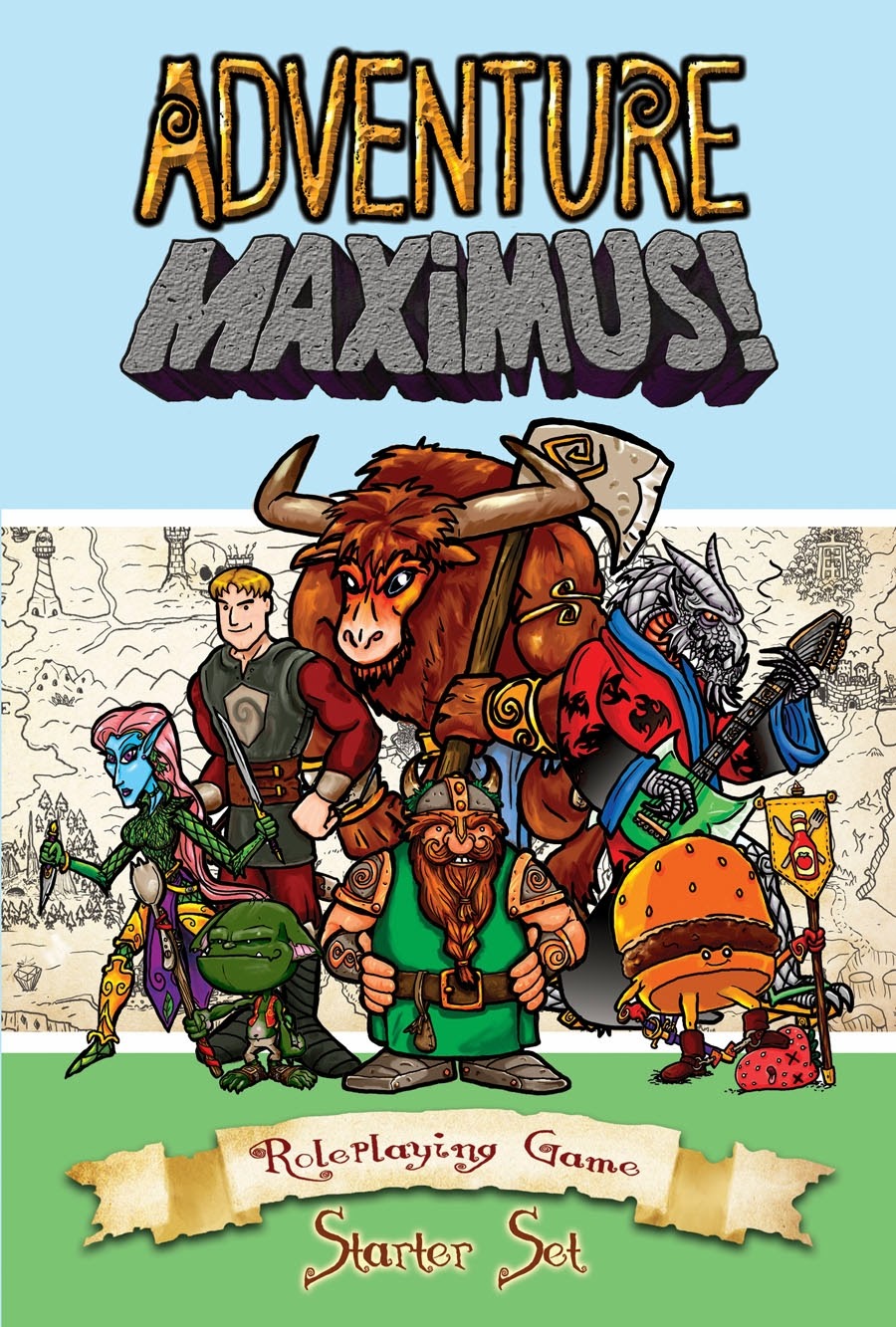
Adventure Maximus! and Risus: RPGing with my 5 Year Old

The Young Lord Shadowmoss, who recently turned 5, has been playing far more Minecraft than is probably healthy. So, Saturday afternoon I suggested we shut down the laptop and break out Adventure Maximus! to resume the adventures of his druid wolf-kin, Squiddy, and his great white shark companion (whose name changes every time, this time it was 'Jaws').

I'm not a fan of the game system (the rules could use some clarifying in my opinion), but the Young Lord likes the  pictures on the cards (as do I), not to mention he has a restaurant with a gargoyle chef and a trimera he befriended in the course of earlier adventures The response was enthusiastic, although it was another 30 minutes before he shut down Minecraft.

That was fine, because I hadn't thought about what to do for an adventure.Thanks to the restaurant, I've used special/rare ingredients as McGuffins many times now but I wanted to mix it up a bit.

This time around, Squiddy was hired by the Big Bad Wolf to clear his name. It seems 'grandma' had been trying to frame Big Bad for some unnamed crime that she had committed. Knowing Squiddy has been desperate to find a sword, Big Bad naturally offered one as a reward - I figured, correctly, that even if he didn't care one iota about the purpose of the adventure, he'd care about that sword. According to the Wolf, grandma was camped out in her cottage at the top of Big Rock Candy Mountain, and so Squiddy prepared for his trek.

I told the Young Lord that Squiddy couldn't possibly carry all of his gear up the mountain (over several adventures he's amassed quite a haul, everything from a pillow to a bow that turns any enemy that it hits into a bunny). The first order of business was preparing for the journey to grandma's house and role-playing packing for the trip- we reviewed all of the equipment and discussed the merits and disadvantages of each, before settling on a modest number of items: 1 range weapon (the aforementioned bunny bow), 1 melee weapon (the snail flail)  and 1 oddball item (gas gun).

Gear selected, he and Jaws made the journey - which I mostly hand-waived other than asking him what if anything he was doing along the way. It turned out, he was very concerned with finding food for Jaws. After some discussion, we decided a special delivery of sandwiches by the gargoyle chef was on the way.

It seemed logical to me.

Near the top of Big Rock Candy Mountain, Squiddy and Jaws, now full on sandiwches, were assaulted by animated snow men - six in all - hurling snowballs at them. Squiddy's first move was to spray the gas gun - missile weapons can't hit through the cloud. I told him right out that I was impressed by that tactical decision and he beamed, and then explained to me why I was impressed.

He was completely wrong, mind you. Still, it's fun to hear how his mind works. I always find the way kids his age rationalize things to be pretty amazing.

In the next round, he surprised me again and instead of jumping into the fight, Squiddy cast his spell to summon a creature to fight alongside him and some pixies showed up and joined the fray. The snowmen went down pretty easily between Squiddy, Jaws and the summoned Pixies..

Grandma, it turned out, was some crazy Ursula-from-The-Little-Mermaid tentacled thing (it's a boss monster in the game, but I forget the name and I'm nowhere near the box to go find the card) and she was pretty tough. When she refused to come quietly and confess her scheme to the law (probably because Jaws broke down the door instead of knocking), the fight was on.

Her first spell charmed Jaws into believing she was his friend. This was a tough choice as a dad, but it seemed the most in character for her - after all, Jaws was right up on her and a clear threat. (I refuse to fudge dice rolls with him either, rolling everything in the open. Call me a hard-ass, but I don't believe in just letting him win.)

Of course, that didn't go over without notice, and the Young Lord did not take it well. He was confused and seemed to think Jaws was now the evil grandma's companion, and I had to continually remind him that Jaws was still his companion, he just happened to like grandma too. In any case, he and by extension Squiddy were ready to destroy grandma now.

Her second spell gave her an extra pair of arms and an extra attack each round. I felt bad about casting this one, figuring Squiddy, without Jaws, might now be outgunned. As luck would have it, I rolled poorly for her attacks thereafter, only causing 1 point of damage to Squiddy.

Besides, I'd forgotten his Summon Creature spell, so, with the help of a summoned pirate and judicious use of his own snail flail, Squiddy put the hurt on grandma, brought her to justice, and claimed his reward.

He was justifiably excited - he earned that sword.

**********
EPILOGUE:

I was pretty drained after our game (it lasted less than an hour but if you have a 5 year old or thereabouts, or ever have, then I think you understand) but he then wanted to try Risus, which I've been trying to get him to try for months now.

I had to seize the opportunity and at least get character generation taken care of.

It seemed to me that the best way to get his character created in such an open ended system would be to guide him with questions to describe what he imagined his character was like and I'd deal with getting him to 4 cliches by asking as many questions as needed.

Here, verbatim, are the answers he came up with as he ran around the room and jumped on the sofa :


  • 1/2 Stormtrooper 1/2 master wizard demon who casts crazy awesome spells and other weird stuff (4) 
  • Protector of other demons (3)
  • Swimmer (2)
  • Gun collector (1)


You can see why the after school teacher pulled me aside the other day to ask if the Young Lord has a lot of toy weapons at home.

Oh, and the character's name? Demon Stormtrooper Wizard Man

Wednesday, September 7, 2016

De Profundis : My First Impression

As DragonCon approached*, I was reminded that I had come across a copy of De Profundis: Cthulhu Gaming on the Edge of Madness in the dealer's hall one year, but passed on it, as I knew the PDF was available from DriveThruRPG for a good bit less. Like so many PDF purchases, it went into the vast pile of bits and bytes to be forgotten.

The other day, I finally put it on my e-reader and gave it a read.


For those who are unfamiliar with it, De Profundis is a:

". . . game of psychological horror . . . De Profundis is a correspondence-based story-telling game that can be played from the point of view of participants from a variety of eras . . . Utilising a mix of letter writing, email and text based gaming - depending on your chosen era of play - it's a perfect game for the modern time strapped gamer."
Sounds pretty cool right?

Better, one of the selling points, as I saw it, is that it can allegedly be played solitaire. As readers may recall, this is my kryptonite.

I say "allegedly" because now that I have read it, I am honestly not sure I understand how to play it.

Or if it's a game at all.

It is, as the author(s) reminds us continually, psycho-drama, and not a traditional role-playing game. For example, there is no GM, there are few if any rules, and it takes place in letters.  True, there are some rules, some tables, dice even get involved - although I will need to read this a 2nd time to make sure I'm right about any of that.

In many ways, it seems to me more of a parlor game of "let's pretend" or telling ghost stories, without the parlor and involving letter writing. For some reason, I imagine haughty rich people sitting in a circle in suits and evening gowns while bedecked in jewels saying "My word!" and "Heavens!" as they play.

That last bit is probably just me though.

Much of the book stresses atmosphere and immersion. In fact, most of the book is written as letters to the reader - which I suppose illustrates how one might play, but I found it distracting: tell me what to do! (wow, I sound like a perfect cog, don't I?) To make immersion easier, to prevent the breaking of illusion, players are encouraged to play themselves, in the real world, but to look for the weird in the ordinary and fill their letters with these mysteries (this wonderfully blurs the lines between reality and "the fiction" to the point that you might end up a raving believer in conspiracy theories. Better get out that tinfoil hat before playing). If playing another personality in a different time period, the book suggests ways of keying the envelope so the recipient can achieve the proper mindset before opening.

So, it sounds like it could be cool, but not very game-like, more like an exercise in creativity and imagination. That's not to dismiss De Profundis  -  I want very much to try it as I love letter writing- but I'm going to need to read it again and then figure out how to go about it.

*the night before DragonCon, I broke my foot and alas I did not get to attend this year.

Monday, January 26, 2015

Some Thoughts on the First Trelleborg Session of 2015

As mentioned previously, I recently ran the first session of 2015 of my ongoing social game campaign, The Trelleborg Campaign. I posted a brief recap of the session over on the campaign blog today.

It was enjoyable, but there are, as always, areas of improvement.

Primarily, i think i could have done  a better job of making the fight seem more epic and the evil more malevolent.

During the game, I did for a second, start to regret the use of the d30 rule a bit when one player used it to deal a massive pile of damage to the salamander. On the one hand, that is the point - a moment of tremendous luck/grace of the gods. At the same time, it's one of many times when the d30 has taken the sting out of an otherwise challenging encounter and I think it actually lessens the threat of danger the players feel.

It was the 2nd time we've played at one of the players' houses, and it seems so far that, compared with the games played at the FLGS, socializing takes a greater priority. I don't dislike it - i rather like getting to know the people in the group outside of what character they play in the game and what their play style is - but at the same time, I am there primarily to play (and have spent hours prepping to do so) and would rather minimize socializing during the game, and do it before and after, and during intermissions. 

Not sure how, or if, I will address this, as two data points is hardly enough to base action on. Ideally, I would create a similar situation as described in How to Run, where players have ample time to unwind and hang out before the game begins.  

Alas, we don't have that flexibility at the moment.

As for next session, i took a quick poll about what they planned next, and the consensus seems to be that they will go and attempt to finish off the white apes (and pick up Snow Ball along the way) who are a thorn in the side of the Nezumi (rat people) on level 3 west. That part of the complex is already mapped and pretty much ready to go, so i will focus on improving my descriptions of atmosphere and tone before then.

Friday, January 16, 2015

Trelleborg's Dungeon:1st Game of the New Year Tonight

Now that the holidays have passed and my players are (mostly) available again, we've scheduled the first session of the year for tonight. I will continue running b/x - despite my liking some of what I saw in the 5e starter set, I have no reason to change systems.

The campaign began as an open table and ran that way until September or October. It took one session with a random player who, perhaps unintentionally, nearly sabotaged the party's plans to form an alliance with the rat people of the third level, to turn it into a closed group by December. The group is solidly 5 players, plus invited guests. Currently the party with hirelings and charmed creatures is some 8 or 10 strong, depending on whether you count the charmed white ape, waiting for the party to return, and the tanner who acts as the party's fence and handles sign ups for the adventurers guild they are forming. 

The campaign has had its ups and downs in terms of my feelings about the sessions. Much of it, I think has been that I have been on my heels often trying to keep up with their plans and machinations - but as I am finally getting ahead of the party again on that front (in terms of the dungeon at least), I'm hopeful that i'll be able to find a grove that works for me. On the plus side, I am happy with how much freedom the players have, and that they take advantage of it- in addition to the adventurers guild, they now have some merchants working with them, and they have sent forth for engineers to submit their bids to rehab the tower above the dungeon, with an eye towards making it their home base. Even tonight they will probably spend their time trying to stop some cultists from opening up a portal to the Abyss and bringing forth Abaddon's diabolical army, rather than exploring further into the dungeon. 

The cultists, and their raiding bandits, were to be a minor encounter to alert the party to the presence of an entire section of the dungeon that they were unaware of. However, the first few times, they showed no interest and that was that but of course, the raids continued, prisoners continued to be taken. A chance wandering encounter roll brought the cultists to the fore again, and this time, with evidence of prisoners recently captured and brought below, they did a little investigating and became incensed by what they found (some of my more gory/twisted descriptions, more at home in a Lamentations of the Flame Princess game).

The party has their work cut out for them: it wouldn't be so bad if the high priest of the cult hadn't turned into a salamander (in b/x a fire elemental lizard thing) that retained his previous form's powers, although he's gone a bit mad as a result of the transformation. 

When we left off in December, the party was in a bit of a panic about how to deal with this unexpected threat. I'll give them some time tonight to make sure they dot their i's and cross their t's to their satisfaction. I don't know how they will try to defeat the cult, but I am sure it's some way I haven't thought of, and I look forward to seeing what they come up with.


Wednesday, October 15, 2014

To Screen or Not to Screen?

One of the things that drew me to punk rock was the idea that the stage isn’t a sanctified space for the performers to deliver their message from behind an imaginary barrier, and upon which the audience could only gaze in adoration. Rather, the stage is just another spot in the room, and there is no barrier, real or otherwise, band and audience blend together until it becomes impossible to determine who or what the performance is and who the audience is. (As a side note, it doesn’t usually work that way. People are conditioned to the audience-performer divide and often play their conditioned roles.)

Abandoning the DM/GM screen is a bit like that - perhaps without the pretension that I packed into that last paragraph - and tears down a wall.

I’m currently reading Alexis Smolensk’s How to Run and he notes that he does not use a DM screen. His reasons for dropping the screen seem to align with my own when it comes to rolling dice in the open so, I thought I would give it a try sometime.

As fortune would have it, last week the FLGS was quite crowded with Warhammer40K players (a new thing at the store and what looks to be a another big draw for them, although not as big as Magic:The Gathering) and rather than the usual two tables, we were consigned to a single small table - which was fine as we had about half of our usual number. Even with just four of us, the table was pretty crowded with character sheets, dice, the abstract combat sheet and miniatures, not to mention my map book, dungeon key, etc.

It seemed like a suitable opportunity to try and run screenless, if only to save some table space.

Despite the authority I am assumed to have as the “DM”, the fact is that I am playing the game, too. My role is different than the roles of other players who are responsible for one or two characters (I let player’s run their hirelings and charmed opponents, unless I think the NPC would refuse or resist the action the player is having them take), but I am still playing the game. Although it's subtle, without the screen, I think there was a definite mental shift on my part, if no on the part the other players.

Was I worried that the others would see my maps? A little, but not because I thought they would cheat (I’m not really sure how you can cheat at playing an RPG).

Rather, when I am running a PC, for me, much of the fun is the discovery of the place; with the map in view (not in the middle of the table mind you), that might be jeopardized. More importantly, to me as a DM, now that I’m trying to give them successes when they roll as such, it makes it harder to modify the map when they find a secret door I didn't know was there.

But that raises the question, what am I afraid of if they see me add it to the map? That I will undermine my role as DM because I am supposed to be all knowing about the game world? (I don’t think that’s written anywhere) That they will know I improvise and that parts of the game are “made up” randomly determined? I don’t worry about this when there is dialog or reactions in combat or when I roll to see how an NPC reacts to a character with a particularly low charisma score, why then in this situation does it matter? Is the map sacrosanct? Is there a rule or unwritten social contract that says Thou Shalt Not Modify the Map in Play! (i don’t mean Quantum Ogring something. For that I think there is indeed a social contract that thou shalt not undermine agency even if you think the other players will never know).

Some people will point out that the screen is helpful not for hiding anything but because it has frequently used information for the DM. I would agree, except, I play war games and typically, war game rules do that on Quick Reference Sheets that are simply held in hand. Why is a screen, usually in a static location on the table, more helpful than sheets you can hold in hand and reference while moving about? (Ever since I played in a DCC game in DragonCon 2013 with one of the most animated GMs I have ever witnessed, I have, for the most part, given up sitting when running a social game.)

In my experience it’s not better, and it might actually be worse.

When I’m standing, reading items at the bottom of a screen is difficult to say the least. The same info held in hand is easily read. That said, I’ve started putting much of the relevant info for creatures, traps, etc. into my key, and memorized most everything else (b/x lends itself to this). Players are responsible for knowing their Saving Throw numbers, To Hit numbers, etc.


I’m running the next session of the Trelleborg dungeon on Friday night and expect to have more players in attendance. I will try it without the screen again and see how it goes.

Monday, September 22, 2014

Adventure Maximus! : Reviewed and a Basic Idea for Solo Play

Adventure Maximus! got its first outing last week (it's part of my 10 games, 10x challenge). If you're not familiar with the game, it's a card based RPG, designed for kids. I backed the Kickstarter awhile back and only recently gave the rules the once over before deciding to bring it with me on vacation.

The whole thing comes in a nice approximately digest-sized box with character sheets, rulebook, Adventure Sheet, cards (lots of cards), 5 blank dice and the stickers to apply to them (rather than using pips, there are three symbols per die: 1 sword, 2 swords and what looks kind of like the "at" symbol).

Character creation is fairly simple: players draw 3 race cards (which detail any special abilities the PC has) and choose 1, then draw three class cards (additional special abilities, armor and weapons) and choose 1. Based on the class card, the player may draw one or more Equipment and Action cards, and, if applicable, Spell cards.

Adventures are Madlib generated (and can cross into the utterly nonsensical as a result - basically, it provides about as much motivation as required for the average dungeon crawl) and individual encounters feature a map card, an equipment card (the treasure) and a creature card. Three encounters make up the adventure, so the third creature is a boss creature encounter. The boss has its own equipment, spells and actions, just like the PCs, which makes them very dangerous.

This mirrors a typical video game pattern and, given the target audience, makes a lot of sense.

From a tabletop perspective though, it is, without a doubt, a complete railroad, no matter how much you improvise - if the players must go to a particular location, and must encounter a particular thing, it's a railroad. I think, for a kids' game, as a way to introduce role-playing, this probably isn't horrible as it makes life easy for the Maximus Master, who might also have no experience with gaming. 

I found thinking of the defined quests as markers to be hit, alleviated some of my aversion to the rails. Also, there is no reason that the Maximus Master can't insert additional locations/encounters along the way and in fact, the rulebook encourages this. Nor are there any scripted resolutions, so player's have at least limited agency.

Ariale, for example, made it past a giant bug simply by avoiding it. She didn't get the loot, but it was a trade off. When she encountered a were-weasel, rather than fight, she parleyed, gave him the wish from her genie lamp which cured him of his lycanthropy and got the treasure that way (plus a bonus XP). She recovered the object of her quest from the big boss in a similar creative fashion, without actually defeating the boss, which left the boss as a potential recurring enemy going forward (if we play again - it doesn't lend itself to chat gaming).

Each PC gets Action Points based on their race card that regenerate per combat round, and can presumably be spent out of combat as well, without restriction. The average for PCs seems to be 3 points. Special abilities, Action Cards, Equipment Cards and Spell Cards all require action points to use. Again, each round of combat, the PC earns their Action Points back, but they may not exceed the maximum allowable for their race.

All dice rolls count successes: a sword = 1 success, two swords = two successes and the "at" symbol thing means 2 successes + roll that die again and add those successes (so, an exploding dice mechanic I guess?). The 5 dice provided, in my limited experience, are more than enough to cover most situations.

Experience Points are given after each encounter, rather than at the end of the adventure. Everyone gets 1 for participating (kind of like those "participant" awards they give to kids just for being on a team) and the Maximus Master can pass out up to 1 additional point per player for roleplaying, creative ideas, etc. Spending the points improve the character in various ways, depending on how many you spend. 

I like this mechanism, as it encourages the player to weigh the risk/reward of saving their points for a bigger upgrade.

I also gave the game a try solo, which I am pretty sure the designers never intended. In fact, given that at least one card bases its duration on the amount of time the player air guitars, I'd have to say it didn't cross their minds.

However, this is why I went in on the Kickstarter: I love cards generally, and the art on these in particular, and I figured I could use the card draws to create scenes and then use various solo techniques to play them out.  Never the less, for the 10 game challenge, I decided that I would try to stick as close to the way the game is meant to be played (that is, rather than re-purposing the decks into my own game).

The big difference was that, while I had to reveal the Map, Equipment and Boss Creature card to generate the adventure,  I only revealed the Map and Creature cards for the first encounter and nothing of the 2nd, until necessary. This way, I could preserve the sense of discovery that I would have in a social game. I used Mythic to run the encounter - it's like second nature anymore to use it, and would allow me to get on with the gaming.

The setup worked well (I'll post a write up of the session as a follow up to this)- my Minotaur Officer clomped around in his full plate to good effect and despite the rails (which I couldn't entirely see thanks to the delayed card draws), with Mythic, it went typically off course each encounter - although i gave up on the third encounter because I ran out of time thanks to some issues with the combat system during the second encounter.

Similar to T&T combats without spite damage, I ended up in a combat that seemed to be interminable - neither side able to rack up damage in any meaningful way due to high armor on both sides. Only by running away from the combat and ducking into a tavern(an act that took 3 tries before I could escape the gargoyles thanks to Mythic and poor die rolls) was I able to end the encounter in an "in game" way. 

Obviously, if I was adjudicating this combat in a social game, the gargoyles would have given up when they realized they couldn't do any damage, but maybe to return later with more of their kind. Solo, it seemed a cheat just to rule that without dice to back it up.

Both sessions were enjoyable, although I think I stumbled with the rules more than I would normally find acceptable. i found more than one card that did not seem to fit the system as described in the rule book, but that's probably just a "me thing" and will be corrected with further experience with the game.

Monday, July 28, 2014

Impressions of Chocolate & Cigarettes : RPG-Lite / Small Scale Skirmish

Chocolate & Cigarettes is a system included with Nuts! Final Edition from THW. This is something new for this edition. It also happens to tap what I think is the sweet spot for THW systems: very small scale skirmish with 3-5 figures making up the entirety of the player's force.

Three skills are used to differentiate your characters beyond REP: Fitness, People and Savvy. There are two additional attribute tables to be used in addition to the attributes normally used during the generation of the player's force. Finally, characters have the possibility of carrying special items that may or may not be useful on the mission (chocolate and cigarettes among them).

Although the regular mechanisms are still used, there is a system for Opposed and Unopposed Challenges - something common to any number of RPGs, lite or otherwise. I like this as it shows that actions more typical of role-playing are expected in these missions.

For my first mission, I brought out my Conte British Paratroopers, hereafter referred to as Corporal Lionel Hardcastle, Lance Corporal Alistair Deacon and Pvt. Stephen Peacock aka Team BBC.

Intel had located a high ranking German officer enjoying a holiday on a remote farm in rural France. Hardcastle and his team were called on to parachute into the area under cover of dark, make their way to the farm and capture the officer. They would rendezvous with the transport team in a village some 3 miles away.

[Night scenarios limit visibility to 12"]

The drop went swimmingly and the team descended on the farm, approaching through a small patch of woods to the south.


Utilizing the hills to their right for additional cover, the team swept right over the crest of the hills, and moved unseen towards the buildings.

[The PEF on my right advanced towards us but was found to be nothing]

On Hardcastle's signal, Peacock and Deacon stormed towards the back of the yellow building, while Hardcastle himself covered the front. 

[The building PEF resolved as nothing, meaning I'd roll 3d6 when entering the building.

The leftmost PEF advanced into range of Hardcastle. It revealed a lone guard on duty]

A lone guard tromped through the darkness, whistling a folk tune. He caught a glimpse of Hardcastle and brought his gun up to his shoulder, but he was too slow.

[Hardcastle won the In Sight and gunned the man down. ]


[Although it's not written anywhere, I really should have tested to see if anyone in the buildings reacted to this but I didn't. To my knowledge, as written, building PEFs don't leave the building (unless they're revealed to be troops]

Peacock and Deacon cleared out the building while Hardcastle kept watch for enemy reinforcements. The building was empty. With no welcoming party other than the lone guard, the team stormed the second building.

[Building PEF was nothing, so 3d6 when door opened. Rather than use the Ready the Grenade test, I used a Savvy challenge, and then did the same with kicking down the door, and putting the pin back IN the grenade after the first floor PEF turned out to be nothing. The upstairs PEF had to be the objective.]

With nowhere left to hide, the team rightly believed the officer must be on the upper floor and Hardcastle joined his men racing up the back stairs.

[I tested In Sight and the German Officer won. I decided to forgo the way the rules usually work and had him dash down the front stairs - that I didn't know existed until I rolled some dice: Does he engage them in a fire fight? 1- Yes and he's turned over a table so he has cover, 2-3 - yes but only until he can fight his way to the front stairs, 4-5 No, but he takes off running down the stairs, 6 No and he surrenders. I rolled a 4. ]


[He won the initiative for the next turn and took off running for the woods and out of sight.]

Team BBC raced down the steps behind the officer. 

[Thankfully the Officer then rolled a 6 for initiative, which meant no action for him. This allowed the team to get within range.]

Unable to catch him, they opened fire and dropped him in his tracks.


Mission : Failed!

***
This is more like it. 

A handful of figures makes it easy to keep track of everything, not too much dice rolling and a loose RPG-Lite feel. In fact, I imagine I could run a solo RPG using this system, and only break out the miniatures when combat necessitated it.

Wednesday, July 9, 2014

Skalafell : The Devil Never Had an Easier Time

[We had a short gaming session the other day, mostly to resolve the cliffhanger]

Fjörgyn heard the clomping feet enter the hut and stayed out of sight a bit as the visitors trashed the outer room. Having had enough, she went to the doorway, sword drawn. A brief confrontation with the three men, dark robes over armor, their faces beat up and bruised, found her informing them that she had disposed of the old man herself. 

[Initial reaction was mixed, but the subsequent check to that bit of news came up 11 - in b/x that's pretty damn friendly!]

Impressed, they asked Fjörgyn about the girl and she happily informed them that she had no idea where or who the girl was but that she had chased her into the hut. The three men quickly found her and Fjörgyn was happy to let them leave with the girl, although not before arranging with the men for one of them to assist her in preparing the old man's body to be dragged back to town inconspicuously.

As with all small talk, conversation turned to his cult, and she made inquires as to membership.

That's right, Fjörgyn wanted in. 

He informed her that a representative would seek her out at the Queen's Cauldron and then the cultists and Fjörgyn parted ways.

The old man's body in tow, Fjörgyn sloughed back to Skalafell to the fully defiled shrine. There a dark cloud hung in an otherwise clear sky, the cries and moans within had silenced, but a torrent of blood poured down the steps into the ground in a seemingly infinite wave. 

Obviously, the thing to do would be to throw the corpse into the bloodfall. 

A wave of crimson rose up and engulfed the offering, dissolving it into its current.

A moment later, a twisted figure, once Sister Rebecca, but now scuttling along with a strange gait appeared in the doorway, its face no longer the plain cleric, but more man-like, pointed and, well, evil. The face, Fjörgyn recognized, was similar to that of the ghoul she had killed.

"You! You did this!" 

Despite Sister Rebecca's face appearing briefly screaming for help, the visage returned to the grotesque caricature and one rather odd exchange later, Fjörgyn had arranged with the evil wizard now posessing Sister Rebecca, to retrieve his spell books, in exchange for his tutelage. 

He gave her a map, and she set out to prepare for her journey.

[Ariale claims she's not sure she's doing this role-playing thing right. Please. ]

Thursday, February 6, 2014

Black Streams : Solo Heroes : A Review


Scarlet Heroes RPG by Kevin Crawford seems to be the darling Kickstarter of the OSR at the moment. And with good reason, I think: it addresses an issue that is not at all uncommon, 1 player with 1 GM.

At least, it's not all that uncommon for me; most of my RPG-life I have GM'd for one or two players. Indeed, in March, I will be running a game for one PC, and my most recent home game was just two PCs.

Now, I haven't pledged my support yet, but I've checked out Black Streams : Solo Heroes, a freebie from Mr. Crawford, and, as I understand it the concepts from it appear in Scarlet Heroes. And what concepts they are!

As promised in the copy, no change is needed to the character sheet, no change of the basic mechanics of your favorite rules set. What he changes is how you use the numbers and how damage is delivered to PCs vs how it is delivered to NPCs/Monsters - and the result is staying power for your 1st level PC even when outnumbered or the victim of poor dungeon delving skills that result in setting off traps.

I can see how this would be useful for using pre-published adventures, where adjusting the size or strength of the encounter would weaken its impact (as opposed to a GM-created adventure that takes the lone PC into account from the very beginning). It also allows for the creation of a different kind of low-level adventure.

If you are committed to the idea that the game is one of nobodies struggling and dying on their way to fame, fortune and hero status, Solo Heroes might cause you some shock.

Why?

Because, now, your 1st level PC can take on 4 skeletons at once and make a good showing of it. The PC isn't a nobody in armor, but an individual better suited to the adventuring life than that. They are a hero of sorts at the outset, in the sense that they are able to withstand blows that would kill another quite easily. For some, this is blasphemy of the highest order.

But, in a one PC game, I'm not sure this is all bad.

While I don't particularly care if a PC I'm playing bites it, character frailty at low-levels does make extended campaign play with a single PC difficult. It also makes playing a Conan or other solitary hero almost impossible. And I know that not everyone is so flippant about their character's survival.

The real benefit to using Solo Heroes, is that it doesn't increase the class abilities of the PC in any way as a side-effect of increasing PC longevity.

Your 1st level Magic-User STILL has just one first-level spell to work with that adventuring day and no more than 7 HP (in the unlikely event they get the  +3 CON bonus). Your 1st level thief is still barely more competent than the average street urchin. Your 1st level cleric has no spells (assuming you're playing B/X as written).

So, you still have the fun of leveling up and gaining power but your risk of dying before you ever see any kind of growth is mitigated. Compare that to the experience you might have if you start your PC at 4th level in order to ensure their survival in a low-level dungeon.

From a solitaire player's perspective, it allows the player to run/identify with a single character instead of having to play an entire party. In essence, it increases the opportunity for deeper role-play in a solitaire game , if that's something you desire.

So, yes, I'll be backing the Kickstarter. If you're unsure it's for you, I highly recommend downloading Solo Heroes though - it's free and usable right away.

Wednesday, February 5, 2014

Say What? Alignment Languages.

I've been thinking about whether or not to use alignment languages in my upcoming B/X mini mega-dungeon campaign. I mean, let's face it, they aren't listed as an optional rule, but they are among the first things dropped or forgotten.

Without doing any actual research, other than reading other blogs, it seems the alignments arise from the assumption that the game world is one that is embroiled in a struggle between the forces of Law and Chaos. All are soldiers in this great war, with the Neutral folks either being wishy-washy, fence sitters or universal harmony types. 

Alignment languages, therefore, allow those on the same side to communicate despite language barriers that arise from differences in geography, species or even plane of existence.

This is rather important when coordinating a war effort on such a grand scale.

If you're playing a fantasy war game with a little bit of role-playing, it's a nice way to justify how you can have a crazy mix of races in a single coordinated army. If you drop the war game aspect, but maintain the existence of this conflict as an important aspect of the world player characters operate in, then it is still important for the same reason.

But what if your focus is the rags-to-riches by-the-blood-on-your-sword story of individuals? There's no universal conflict in which the PCs are actors.  There is no epic struggle of Law vs. Chaos, just survival in the face of an uncaring universe.

This raises the question, why have alignments at all?

Perhaps they are residue of a previous conflict? Or maybe, more likely, as someone somewhere suggested, they are an out-of-game mechanism for a character's in-game conscience (personally, I love that justification of the alignments).

However, I suspect that most GMs don't drop alignments, only the languages.

But, the alignment languages can still be useful for the very same reason they're useful in a grand war of ideology: they remove linguistic barriers. A party of humans with average intelligence scores who know no other additional languages but have a member of each alignment can communicate with just about any intelligent (as defined in a humanocentric way) creature they meet!

Unfortunately, the details of the languages seem absurd. In particular, if you change alignments, you immediately forget the old language and know the new one. The only justification I can come up with for this is a divine intervention of some kind. And that works if your world is a battleground for the forces of Law and Chaos, because the gods probably care one way or another. 

But I'm pretty sure the gods in my game world don't give a rats butt, because the conflict ISN'T a great war, but a personal struggle. They exist, they occasionally reward their followers, but mostly they're concerned with their own goals and interests.

So, i'm torn: 

I can reject the languages wholesale, which I think takes away an opportunity for players (even if it's one they might not miss) or I can try to come up with a better mechanism to handle the effect an alignment change has on the language, because you know if I don't, it'll surely come up.

Friday, January 31, 2014

January 2014 Updates

This is one of those updates where I just lump everything together: role-playing, wargaming, zine-ing, etc.
    A scene from a favorite song on Adventure Time
    It has nothing to do with this post.
  • Of late, I've been working on issue #2 of 6 Iron Spikes & a Small Hammer as often as possible. I'm deep in editing and revising - I seriously feel that I have to step up my game to accompany the amazing artwork I received.
  • The majority of my hobby time not spend on the zine has been spent on finishing a mere six Swedish infantry for the Great Northern War by 11:59 PM tonight. Clearly, there's no consequence if I don't, it's just something I want to do. As it is, I've had to revise my original painting plan, and allot 3 months for every 2 months of GNW painting goals.
  • Inking in of the Ever Expanding Dungeon map continues. It's tedious, not difficult. Once done, I'll scan it and post it with each session summary and indicate where the action is taking place.
  • I've tentatively scheduled the first game of an ongoing open table dungeon crawl campaign for my local meetup group for later in February. The dungeon is not one of my own design, but I still have prep work to do.
  • Finally, the budget tally:
January Budget: $15.00
YTD Budget: $15.00
January Actual:  $37.35
    • BMC Iwo-Jima 32 Piece Set 
    • Britain's Kublewagen
YTD Actual: $37.35

So, as you can see, not a great start on the budget .On the other hand, if I don't buy anything in February (not counting any birthday funds I might receive), I'll be back on pace in March.

It looks like I have 28 really long days coming up!

Sunday, December 29, 2013

My Finalized List of 2014 Hobby Objectives

Once again, I realize that having objectives or goals for a hobby might strike some as being directly at odds with the fact that it is a hobby we're talking about. However, I have a tendency, like many, to have gamer ADD and thus, I find this a useful exercise. 

My list posted previously was quite enormous. It was too much, despite the fact that many of them were rather easy to knock out. More importantly, looking at the list didn't excite me.

So, after much contemplation and effort to suss out from my giant list what's important to me, what I would find satisfying, and what I might not do without the added kick in the butt publicly declaring a goal gives,  I've settled on the following for 2014:

Great Northern War Project

  • Play The Advance Guard Action Teaser by June 30, 2014.
  • Play a historical scenario by 12/31/14 - Roos attack on the 3rd redoubt at Poltava seems a good candidate.

Details for how I'll get my forces to this point are here.

Fantasy Gaming 

  • Run a monthly Labyrinth Lord episodic campaign at an FLGS for the Atlanta Gamer's Guild meetup.
  • Run 2-4 sessions of Labyrinth Lord at DragonCon (I'm waffling on running 4 sessions now, worrying I won't have any energy left to play in other games or go to any panels). 
  • Run "Japantasy" game for home group

WWII 

  • Rising Sun: Operation Watchtower (Britton Publishers)- Play the following Guadalcanal scenarios: The Goettge Patrol , The Brush Patrol, The First Battle of Matanikau, The Battle of the Tenaru, Battle of Bloody Ridge, September Matanikau, Paige's Platoon, Koli Point
  • Red Guards at Kursk (Skirmish Campaigns) - Play"The Red Surge" 4 scenario campaign, which covers July 11 and 12, 1943. 

Helvetica
  • Play 6 campaign encounters.


Much of what I have mulled over previously is included there, but it's a layer or two down;  I decided to keep the end in mind, rather than the means. 

It's purely psychological.

I most enjoy playing wargames, not the preparation to play them. Whereas, for RPGs, I love the planning. This way, my goals focus on the parts that I most enjoy and find most satisfying.

Friday, December 20, 2013

Character as Party

I was talking Ovy Ortega, an avid solo dungeon delver, today on gchat and he asked if I use Unbelievably Simple Roleplaying (USR) or Microlite. 

He noted that he was looking to do a dungeon crawl, where the party was a character. (emphasis mine)

This sent my brain in a spin: USR seems perfect for this, although I have yet to try these ideas out.

Option 1: Standard USR Character

Your Action die represents your fighter, your Wits die represents your magic-user and your Ego die represents your Cleric.

Give each stat a specialism. Probably something like Melee (A+2), Arcane spells (W+2), Divine Spells (Ego + 2).

Calculate HP for the party as if it were a single character (Action + Wits, so yes, your M-U will bring down the party average, as they should) and assume that damage is equally distributed. 

Combat would be handled as normal but would be very abstract. It also means no one character will die, and you'll end in a TPK when reduced to 0.


Option 2: Standard USR Character version 2

As above, but roll HP for each stat (member of the party). All participate in combat individually. Damage goes to the individuals. At 0, that member of the party is dead.

This could require fiddling with how you handle NPCs and monsters to make combat fair for both sides.


Option 3: Replace the Standard Stats with Classes

If you stick with the standard character creation, you're stuck with a max of 3 members of the party. Now, even if you're not fond of the thief, it still leaves out illusionists, bards, monks, etc.

Rename the stats, Fighter, Magic User, Cleric, or what have you, and add as many more as you'd like. 

Assign a die to each. You probably don't want to go much above d12 for a single stat (and I would limit that to just 1 of the members), unless you want a truly superhero group or below a d6 for the party's classed members. Obviously, do what you want. d30 for your fighter? Sure, maybe he's Conan, or He-Man or something.

Give each a specialism, something class appropriate. 
 
In this case, for HP, I would go with a lump - roll all the dice and add together. This really allows the party to be played as a single character. It also gives them staying power - maybe too much if you like life/death of your characters to hang in balance - you might drop the highest and lowest or something, to make a weaker or stronger party as desired.

As my notes in Option 2 imply, I'm not fond of the idea of tweaking the rules for individual HP per stat. The abstract combat really appeals to me.

As Ovy noted in our discussion, you could assign A: d20 to a group of orcs. That "group" is just 1 combat die roll, as is the party's combat roll. Just like standard USR.

I love the simplicity in that; let your narrative describe the details of who does what, not the mechanics.

Sunday, December 8, 2013

The Purple Worm Graveyard : Another Social Game for Strangers

Saturday, at Giga-Bites Cafe in Roswell, I ran my second old school one-shot featuring B/X. 

Like last time, I decided to run a published adventure, rather than one of my own. This time, the players would venture into The Purple Worm Graveyard, a short module for low level PCs (1st - 4th) from Planet Thirteen. At just $6.00 for the print and PDF, you can't go wrong and the cover is too cool to not buy the print copy! 

photo from Planet Thirteen site:
 http://planet-thirteen.com/Purple.html
I had four players, three of which played in my last game (making the word "strangers" somewhat questionable) and one new, who had only played 4th ed. You can imagine his shock when he rolled up a character in under 30 minutes.

The party consisted of 1 elf, 1 cleric and 2 thieves. Not exactly the makeup of a party with "long term survival" oozing from them. In the first encounter, I almost had a TPK on my hands.

On their initial foray, they made their way down a hall to a chamber without a door. The elf moved to the front to use his infravision to check things out.

Despite hearing something singing Barry White, interspersed with gnawing and chewing (yes, i sang some of Barry White's  I Can't Get Enough of Your Love Babe and made flesh munching sounds), they decided to go SWAT team on the room's inhabitants. First a torch was thrown into the room for light, which by luck (i.e. the dice) didn't go out, and in their favor, they achieved surprise. This was followed by a hail of missiles after which melee was joined and rather vicious, as much for the PCs as the monsters.

The party survived due to a failed morale roll for the monsters, but then, as they searched the room and then discussed going to town to hire some retainers, i rolled the d6 for wandering monsters and up came a '1'. Fortunately, it was just a lone grub and bug infested zombie and the party made short work of it - a magic missile finally blowing it to pieces, scattering bone, dust and bug bits everywhere.

The added "muscle" (a gardener and a poet) wasn't much help, but, by a wonderfully creative solution, the party survived an encounter with a 15HD, 72 HP, purple worm with only 1 PC death (Sadly, the guy who has only played 4th ed. Well, we warned him that the game is deadly) and managed to make out with as much loot as they could carry.

I'm not going to tell you HOW the party did it, but it was pretty rad, required rolling the dice, and didn't succeed on the first attempt.

***
On the whole, I felt more relaxed this time, but I was lacking some energy - between having a cold that I'm just recovering from and not getting much sleep thanks to my 2 year old, I was worried i couldn't bring my A game. A Monster Energy Drink helped a bit with that.

I remembered to buy 2 waters right up front and I did better keeping track of initiative, although that's probably due to the general lack of combat (3 total, I think).

For the PC that died, the player rolled the damage die for the purple worm, so at least it put the chance of survival on his luck with the dice and not mine. That got a positive reaction and I think I'll try to work that in more often.

Everything was rolled in the open - if it wasn't, it was accidental on my part. I don't think this detracted from the suspense or the excitement. Instead, everyone watched the die roll and felt relief, or groaned, at the result.

My new GM screen worked well, but I still have trouble reading the To Hit table for monsters. When I start my campaign in 2014, I'll be sure have an easily readable copy on an index card with the values i'll need to look at most often on it - i.e. if i know the monsters don't have more than 3 HD, then i only need those lines of the table on the card.

Although I originally was thinking about some kind of actual sandbox world, or a mega-dungeon campaign, I'm now thinking an episodic campaign, in which I can work in various modules each session, might be fun. 

As for the module itself, it's short (13 rooms and change). It could all end rather early depending on which way the party chooses to go at any given intersection. However, my only real issue was the lack of dimensions for the rooms and halls, but that was solved by tracing the map onto graph paper.

Friday, November 22, 2013

Sisters of the Sword: Game Potential


Recently, I read the YA novel Sisters of the Sword by Maya Snow, as part of my ever continuing research on feudal Japan, Japanese folklore, and feudal Japanese themed stories.

The plot, to my mind, has excellent potential for an RPG campaign starter:


Two sisters, daughters of nobility, secretly witness the murder of their father and brothers and the slaughter of the servants. Vengeance is sworn but the sisters know they are not able to extract it because they do not yet have the training or discipline. When they run to find their mother and infant brother, they are nowhere to be found, but a message found later gives them hope.

That's all you need to know to get started I think.

  • As in many good samurai stories, vengeance is prime motivator for the overall story.
  • From a game point of view, their lack of ability as low level characters combined with this motivation, provides an in-game purpose to gain levels/ability/skills.
  • The PCs have learned a variety of combat skills outside what might be usual for their age, from their brothers and father (in-game justification of starting skills)
  • The characters can choose how they want to approach their revenge: whether to expose the murderer by gathering evidence or to strike them down in combat (or whatever other way they can imagine)
  • Finding their mother and infant brother (rightful heir to their murdered father's position), if they choose to do so, becomes a sub or parallel plot. 
  • Finding their mother and infant brother provides an easy way to motivate characters to travel or to take up side-quests  ("A mysterious letter arrives, you recognize the handwriting as your mother's own") 
  • The villain knows the daughters, mother and infant son are not dead and has sent his samurai to find them - life on the run becomes a major catalyst for in-game events.
  • There are four ready-made encounter-areas, that the PCs know of, to take from the book:
    1. the family home
    2. the family shrine hidden deep in the forest
    3. the nearby village
    4. a dojo of a great master who trained their father, the villain, their brothers and the villain's son (in the book, they stumble on this, but it's certainly possible they know of its location. Also since the characters are girls, they have to disguise themselves as boys to get into the school. If the PCs are girls, then protecting their secret and life at the dojo can become adventures in themselves)
  • The master (if they meet him) is a potentially useful NPC, well fleshed out in the book, as are several other students (one of which the author seems to hint is of a ninja clan by birth).
As for the book, to my dismay, this is the first book in a series, which I am now going to have to finish reading because I really want to know how it all turns out!

Wednesday, November 20, 2013

Recent Arrivals

A few weeks ago, Rick Loomis of Flying Buffalo posted on the T & T Kickstarter mailing list that he had found some shrink wrapped boxed T & T 5.5 and a copy of 7.5.

I have T & T 5 and really wanted 5.5, which includes some setting bits, so it was a no brainer (besides, it comes with Buffalo Castle):


When I finally open it, some collector somewhere will let out a sad cry, I'm sure.

On Saturday, I took a drive out to Titan Comics in Smyrna, to check out the table space available for playing RPGs, and while I was there I picked up a couple of comics:


 These are from the Lulu 40% off sale:


I haven't started Whitehack, but I have broken into Non-Player Characters. So far, I'm loving the approach to handling social encounters.

Finally, after using a Kroger Raisin Bran box to make my screen for the Dungeon of Akban session, I decided I needed something a little more robust for my GM screen. Plus, I wanted one that could be used for multiple systems - changing out whatever was needed.

I found a video online that shows how to make a GM screen from 3-ring binders clipped together. And it looked to me like it would fitthe bill perfectly.

A box of four white 3-ring binders is available for $5.99 with free delivery w/Amazon Prime. A few days later and voila! (and I still have 2 binders to use for whatever)