Showing posts with label reviews. Show all posts

Wednesday, September 7, 2016

De Profundis : My First Impression

As DragonCon approached*, I was reminded that I had come across a copy of De Profundis: Cthulhu Gaming on the Edge of Madness in the dealer's hall one year, but passed on it, as I knew the PDF was available from DriveThruRPG for a good bit less. Like so many PDF purchases, it went into the vast pile of bits and bytes to be forgotten.

The other day, I finally put it on my e-reader and gave it a read.


For those who are unfamiliar with it, De Profundis is a:

". . . game of psychological horror . . . De Profundis is a correspondence-based story-telling game that can be played from the point of view of participants from a variety of eras . . . Utilising a mix of letter writing, email and text based gaming - depending on your chosen era of play - it's a perfect game for the modern time strapped gamer."
Sounds pretty cool right?

Better, one of the selling points, as I saw it, is that it can allegedly be played solitaire. As readers may recall, this is my kryptonite.

I say "allegedly" because now that I have read it, I am honestly not sure I understand how to play it.

Or if it's a game at all.

It is, as the author(s) reminds us continually, psycho-drama, and not a traditional role-playing game. For example, there is no GM, there are few if any rules, and it takes place in letters.  True, there are some rules, some tables, dice even get involved - although I will need to read this a 2nd time to make sure I'm right about any of that.

In many ways, it seems to me more of a parlor game of "let's pretend" or telling ghost stories, without the parlor and involving letter writing. For some reason, I imagine haughty rich people sitting in a circle in suits and evening gowns while bedecked in jewels saying "My word!" and "Heavens!" as they play.

That last bit is probably just me though.

Much of the book stresses atmosphere and immersion. In fact, most of the book is written as letters to the reader - which I suppose illustrates how one might play, but I found it distracting: tell me what to do! (wow, I sound like a perfect cog, don't I?) To make immersion easier, to prevent the breaking of illusion, players are encouraged to play themselves, in the real world, but to look for the weird in the ordinary and fill their letters with these mysteries (this wonderfully blurs the lines between reality and "the fiction" to the point that you might end up a raving believer in conspiracy theories. Better get out that tinfoil hat before playing). If playing another personality in a different time period, the book suggests ways of keying the envelope so the recipient can achieve the proper mindset before opening.

So, it sounds like it could be cool, but not very game-like, more like an exercise in creativity and imagination. That's not to dismiss De Profundis  -  I want very much to try it as I love letter writing- but I'm going to need to read it again and then figure out how to go about it.

*the night before DragonCon, I broke my foot and alas I did not get to attend this year.

Friday, February 27, 2015

10 Games, 10 Times: Iron Ivan's Disposable Heroes / Coffin for Seven Brothers

Soviets try to get their tanks across the table in a later game in the series.
i had played DH/C7B a handful of times before, initially not really digging it, but later coming to decide that it might well be my favorite set or 1:1 WWII gaming, for squad to a platoon per side. Yet, I hardly played it thereafter, and when i did, it was primarily infantry only conflicts, hence its inclusion on my 10 Games, 10 times challenge list.  


The first few games were straight up infantry affairs to help me shake off the cobwebs and figure out where I was forgetting rules.
Backing up, for those who don't know, DH/C7B is a 1:1 set of WWII skirmish rules, where the basic unit is the fire team. It's recommended for up to a platoon per side, with support, although you can extend it further if you have time or multiple players.

My sole gripe with the rules is the use of markers for tracking activation, pinned, acquisition status (for armor), and # of armor penetration hits. You also need some way of tracking the number of destroyed units for each side, as these, plus the # of currently pinned units effect the initiative score.

So many markers. The white cards are blinds - I used Platoon Forward for many scenarios, along with its enemy force generation method. This is from one of the last games I played in the series - after I had mounted the figures to 3 inch squares.
However, so many games require markers, that it seems like short of an all or nothing approach to hits, or off table tracking (difficult in a 1 figure = 1 man game with more than a handful of figures per side), there really isn't a better option.

So, other than that, the game has a lot going for it although it took me 5 or so games to really see how good they were, as I kept forgetting rules in the early games or situations just didn't come up:
  • The Guts score - it effects both initiative and morale, including the ability to rally. It's a mix of quality and motivation.
  • simplified movement
    • if one figure reaches cover, the whole group does
    • move one figure, then place the rest around that figure, rather than measuring for all
    • terrain does not effect movement rates of infantry
    • Movement rate determines what additional actions a unit may perform and any penalties
  • Snap (opportunity) fire is restricted to one enemy unit.
  • Using grenades to supplement a charge is abstracted and works quite smoothly
  • Taking fire, regardless of result, triggers a Guts check - this seems right to me, but surprisingly few systems I have played incorporate it
  • It is difficult to score a hit on a target in cover - based on what i've read about the expenditure of ammo in WWII to hit a target, this too seems right to me.
  • The way it handles armor.
I wanted to really go big,both because i wanted to see if it made a big difference in my enjoyment, and also as a way to see if I could at some point eliminate a table and the space it takes up. Playing on the floor was loads of fun but no more so than a table, as it turns out.

One thing that has flummoxed me about some other systems at the 1:1 scale has been armor: either they are too simple, and the type of vehicle does not matter, or too complex to the point of having to use calculus to understand the tables. DH/C7B's system for attacks by and against armor sits somewhere in the middle and I rather like it. It has enough flavor to get a feel for the period and the differences in equipment, but not so complicated that every rivet matters.

I had to fudge any vehicle that wasn't a tank, since no stats are included in the core rules beyond a vehicle or two per army.
One  downside is the mix of roll low/roll high is somewhat annoying - you want to roll low always -to acquire a target, to hit, to pass a Guts check, but  when you're rolling for armor penetration, then you want to roll high. 

It's hard to see, but the PZ. IV had just made it onto the table when one of the T-34s brewed it up on a single hit This is less frequent an occurrence than my pictures might relate.
The other is that the core rules, which contain the "big four" nations, do not include much in the way of vehicles for these. As such, I had to fudge a bit on anything not remotely covered. The force supplements contain the desired data but those are additional purchases.

The core rules do, however, cover tank riders!
Once again, the 10 Games, 10 Times Challenge comes through, and I have a new understanding and appreciation for this game. That said, I also have come to realize, that i prefer 1:1 games with 3-5 figures, rather than squad to platoon sized engagements. 

As a bonus, I suspect these rules could work well for that - treating each figure as their own fire team and disregarding the man-alone rule and the "only 1/2 figures per unit can shoot" rule. I may try them in that respect at some later date, but Five Men in Normandy awaits first.


Monday, September 22, 2014

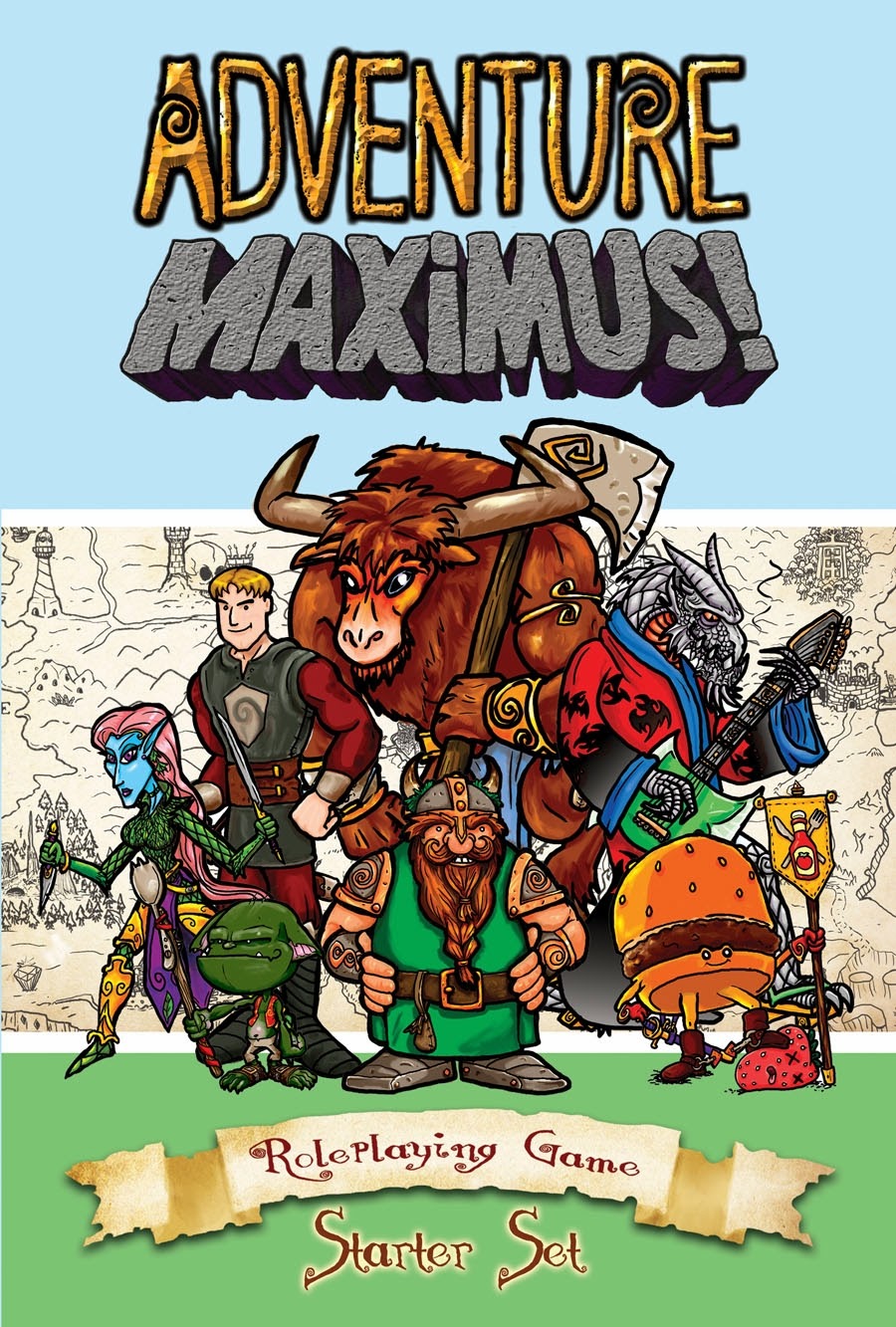
Adventure Maximus! : Reviewed and a Basic Idea for Solo Play

Adventure Maximus! got its first outing last week (it's part of my 10 games, 10x challenge). If you're not familiar with the game, it's a card based RPG, designed for kids. I backed the Kickstarter awhile back and only recently gave the rules the once over before deciding to bring it with me on vacation.

The whole thing comes in a nice approximately digest-sized box with character sheets, rulebook, Adventure Sheet, cards (lots of cards), 5 blank dice and the stickers to apply to them (rather than using pips, there are three symbols per die: 1 sword, 2 swords and what looks kind of like the "at" symbol).

Character creation is fairly simple: players draw 3 race cards (which detail any special abilities the PC has) and choose 1, then draw three class cards (additional special abilities, armor and weapons) and choose 1. Based on the class card, the player may draw one or more Equipment and Action cards, and, if applicable, Spell cards.

Adventures are Madlib generated (and can cross into the utterly nonsensical as a result - basically, it provides about as much motivation as required for the average dungeon crawl) and individual encounters feature a map card, an equipment card (the treasure) and a creature card. Three encounters make up the adventure, so the third creature is a boss creature encounter. The boss has its own equipment, spells and actions, just like the PCs, which makes them very dangerous.

This mirrors a typical video game pattern and, given the target audience, makes a lot of sense.

From a tabletop perspective though, it is, without a doubt, a complete railroad, no matter how much you improvise - if the players must go to a particular location, and must encounter a particular thing, it's a railroad. I think, for a kids' game, as a way to introduce role-playing, this probably isn't horrible as it makes life easy for the Maximus Master, who might also have no experience with gaming. 

I found thinking of the defined quests as markers to be hit, alleviated some of my aversion to the rails. Also, there is no reason that the Maximus Master can't insert additional locations/encounters along the way and in fact, the rulebook encourages this. Nor are there any scripted resolutions, so player's have at least limited agency.

Ariale, for example, made it past a giant bug simply by avoiding it. She didn't get the loot, but it was a trade off. When she encountered a were-weasel, rather than fight, she parleyed, gave him the wish from her genie lamp which cured him of his lycanthropy and got the treasure that way (plus a bonus XP). She recovered the object of her quest from the big boss in a similar creative fashion, without actually defeating the boss, which left the boss as a potential recurring enemy going forward (if we play again - it doesn't lend itself to chat gaming).

Each PC gets Action Points based on their race card that regenerate per combat round, and can presumably be spent out of combat as well, without restriction. The average for PCs seems to be 3 points. Special abilities, Action Cards, Equipment Cards and Spell Cards all require action points to use. Again, each round of combat, the PC earns their Action Points back, but they may not exceed the maximum allowable for their race.

All dice rolls count successes: a sword = 1 success, two swords = two successes and the "at" symbol thing means 2 successes + roll that die again and add those successes (so, an exploding dice mechanic I guess?). The 5 dice provided, in my limited experience, are more than enough to cover most situations.

Experience Points are given after each encounter, rather than at the end of the adventure. Everyone gets 1 for participating (kind of like those "participant" awards they give to kids just for being on a team) and the Maximus Master can pass out up to 1 additional point per player for roleplaying, creative ideas, etc. Spending the points improve the character in various ways, depending on how many you spend. 

I like this mechanism, as it encourages the player to weigh the risk/reward of saving their points for a bigger upgrade.

I also gave the game a try solo, which I am pretty sure the designers never intended. In fact, given that at least one card bases its duration on the amount of time the player air guitars, I'd have to say it didn't cross their minds.

However, this is why I went in on the Kickstarter: I love cards generally, and the art on these in particular, and I figured I could use the card draws to create scenes and then use various solo techniques to play them out.  Never the less, for the 10 game challenge, I decided that I would try to stick as close to the way the game is meant to be played (that is, rather than re-purposing the decks into my own game).

The big difference was that, while I had to reveal the Map, Equipment and Boss Creature card to generate the adventure,  I only revealed the Map and Creature cards for the first encounter and nothing of the 2nd, until necessary. This way, I could preserve the sense of discovery that I would have in a social game. I used Mythic to run the encounter - it's like second nature anymore to use it, and would allow me to get on with the gaming.

The setup worked well (I'll post a write up of the session as a follow up to this)- my Minotaur Officer clomped around in his full plate to good effect and despite the rails (which I couldn't entirely see thanks to the delayed card draws), with Mythic, it went typically off course each encounter - although i gave up on the third encounter because I ran out of time thanks to some issues with the combat system during the second encounter.

Similar to T&T combats without spite damage, I ended up in a combat that seemed to be interminable - neither side able to rack up damage in any meaningful way due to high armor on both sides. Only by running away from the combat and ducking into a tavern(an act that took 3 tries before I could escape the gargoyles thanks to Mythic and poor die rolls) was I able to end the encounter in an "in game" way. 

Obviously, if I was adjudicating this combat in a social game, the gargoyles would have given up when they realized they couldn't do any damage, but maybe to return later with more of their kind. Solo, it seemed a cheat just to rule that without dice to back it up.

Both sessions were enjoyable, although I think I stumbled with the rules more than I would normally find acceptable. i found more than one card that did not seem to fit the system as described in the rule book, but that's probably just a "me thing" and will be corrected with further experience with the game.

Friday, August 8, 2014

Team BBC is Off the Air

The other night I played my 3rd game of Nuts! using the Chocolate & Cigarettes rules, and the 10th game of Nuts! Final Version. 

The picture speaks volumes:

No custard tarts today.
Things got off to a bad start when the first PEF resolved as a squad with 6 members and Deacon was knocked out of the fight. That was on turn 1. 

Although Hardcastle killed the German NCO, and managed to drive off the LMG crew (they passed 0 on Man Down test and left the battlefield), the Germans ended up receiving a reinforcement of another LMG crew on the next turn, so no gain there.

Both Peacock and Hardcastle were eventually dropped as Out of Fight as seen above. So, they aren't dead, but they are undoubtedly prisoners of war now. 

Perhaps an escape scenario will occur at some point in the future?

****
As for Nuts! Final Version, this was the 10th game in the 10 game challenge. There is no doubt in my mind that the experiment proved its worth. I feel  I know the game far better than I knew the previous edition and I've given it a genuinely fair shake.

I think the Chocolate & Cigarettes size games work quite well, although I had no chance to use any of the challenge rules for the additional character stats. This was a result of the scenario choices I made and not a function of the rules. Maybe if I play an escape scenario, they will see some use.

I won't be using Nuts! as my default squad to platoon rules, but will Nuts! Final Version : Chocolate & Cigarettes become a staple? 

I recently acquired Five Men in Normandy, so, some day I'll be trying those out, but in the meantime, I think Nuts! FV: C&C is just about perfect for this type of game, providing lot's of action and drama with just a few figures per side.

Monday, July 28, 2014

Impressions of Chocolate & Cigarettes : RPG-Lite / Small Scale Skirmish

Chocolate & Cigarettes is a system included with Nuts! Final Edition from THW. This is something new for this edition. It also happens to tap what I think is the sweet spot for THW systems: very small scale skirmish with 3-5 figures making up the entirety of the player's force.

Three skills are used to differentiate your characters beyond REP: Fitness, People and Savvy. There are two additional attribute tables to be used in addition to the attributes normally used during the generation of the player's force. Finally, characters have the possibility of carrying special items that may or may not be useful on the mission (chocolate and cigarettes among them).

Although the regular mechanisms are still used, there is a system for Opposed and Unopposed Challenges - something common to any number of RPGs, lite or otherwise. I like this as it shows that actions more typical of role-playing are expected in these missions.

For my first mission, I brought out my Conte British Paratroopers, hereafter referred to as Corporal Lionel Hardcastle, Lance Corporal Alistair Deacon and Pvt. Stephen Peacock aka Team BBC.

Intel had located a high ranking German officer enjoying a holiday on a remote farm in rural France. Hardcastle and his team were called on to parachute into the area under cover of dark, make their way to the farm and capture the officer. They would rendezvous with the transport team in a village some 3 miles away.

[Night scenarios limit visibility to 12"]

The drop went swimmingly and the team descended on the farm, approaching through a small patch of woods to the south.


Utilizing the hills to their right for additional cover, the team swept right over the crest of the hills, and moved unseen towards the buildings.

[The PEF on my right advanced towards us but was found to be nothing]

On Hardcastle's signal, Peacock and Deacon stormed towards the back of the yellow building, while Hardcastle himself covered the front. 

[The building PEF resolved as nothing, meaning I'd roll 3d6 when entering the building.

The leftmost PEF advanced into range of Hardcastle. It revealed a lone guard on duty]

A lone guard tromped through the darkness, whistling a folk tune. He caught a glimpse of Hardcastle and brought his gun up to his shoulder, but he was too slow.

[Hardcastle won the In Sight and gunned the man down. ]


[Although it's not written anywhere, I really should have tested to see if anyone in the buildings reacted to this but I didn't. To my knowledge, as written, building PEFs don't leave the building (unless they're revealed to be troops]

Peacock and Deacon cleared out the building while Hardcastle kept watch for enemy reinforcements. The building was empty. With no welcoming party other than the lone guard, the team stormed the second building.

[Building PEF was nothing, so 3d6 when door opened. Rather than use the Ready the Grenade test, I used a Savvy challenge, and then did the same with kicking down the door, and putting the pin back IN the grenade after the first floor PEF turned out to be nothing. The upstairs PEF had to be the objective.]

With nowhere left to hide, the team rightly believed the officer must be on the upper floor and Hardcastle joined his men racing up the back stairs.

[I tested In Sight and the German Officer won. I decided to forgo the way the rules usually work and had him dash down the front stairs - that I didn't know existed until I rolled some dice: Does he engage them in a fire fight? 1- Yes and he's turned over a table so he has cover, 2-3 - yes but only until he can fight his way to the front stairs, 4-5 No, but he takes off running down the stairs, 6 No and he surrenders. I rolled a 4. ]


[He won the initiative for the next turn and took off running for the woods and out of sight.]

Team BBC raced down the steps behind the officer. 

[Thankfully the Officer then rolled a 6 for initiative, which meant no action for him. This allowed the team to get within range.]

Unable to catch him, they opened fire and dropped him in his tracks.


Mission : Failed!

***
This is more like it. 

A handful of figures makes it easy to keep track of everything, not too much dice rolling and a loose RPG-Lite feel. In fact, I imagine I could run a solo RPG using this system, and only break out the miniatures when combat necessitated it.

Thursday, July 24, 2014

Some Thoughts on the Ten Games, Ten Times Challenge

I'm 22% into the 10 games, 10 times, challenge and I thought I should post an update, because I think the experience has already been worthwhile.

What I am finding, and it confirms what I think most of us already know, that multiple plays of a game help reinforce knowledge of the rules, help us learn and improve strategy and tactics, and help us decide how we really feel about a game beyond the first impressions.

By way of example:

One of the games on my list, Urbion, is a solitaire card game that offers both a basic game, and several advanced options, all within one box. 

I had thought when I started that I would focus on getting into those advanced options, since I had already played the basic game a number of times. 

However, I found on the first game  after I officially declared the challenge for myself (and game here means gaming session. I can play multiple games of Urbion in an hour, but I only count that as 1 for the sake of the challenge) that I not only needed a complete rules refresher, but that I had been doing a few things incorrectly the first 5 games which I had credited myself.

It wasn't until the 7th game that I finally won playing the basic rules. 

The game was harder to win than I thought it might be, but, with repeated play, I had developed some strategies that seemed to work, and i was seeing things I could do each game turn that I couldn't see in those earlier games.

About 2 weeks passed between the 8th and 9th session, and so I decided to stick with the basic game. Lo and behold, I remembered the rules! I didn't win mind you, but I played well enough to feel like it was time to try the first of the advanced options.

In the 10th game, I tried the first of the advanced options. 

They add a fair degree of difficulty and the first option alone includes many possible choices. I greatly underestimated the depth of this game in the sense that I thought I'd explore the all of the advanced rules, or at least many, in 10 games.

This was a pleasant surprise and I see that I will get many more hours of enjoyment from this game. So, despite having completed the challenge for Urbion, I will continue playing it.

Awesome, right?

Well, all is not rainbows and unicorns in the realm of Ol' Tabletop:


I have played 7 games now of Nuts! Final Version, and all of these games have been infantry only. I have yet to touch the vehicle rules, nor have I tried the Chocolate & Cigarettes rules. 

Whenever I played Nuts! 2.0, I was always looking up something or other, and that was the case when I started playing Final Version. However, by game 5, except for the non-player "ai" and the reinforcements table, I needed to only refer to a chart once in awhile; repeated play has its merits. 

By the time I finished the 6th game (which was the first mission I completed successfully), I was feeling dissatisfied and started to consider whether or not I should cut my losses and pick a different game to play ten times. 

Another benefit of repeated play: This is a game that at first i was quite happy with but something about the game, after several plays had soured that - having the experience of playing multiple games of Nuts! meant I had data to mine to find the source of my dissatisfaction.

What I found was, it's not the rules generally, but that I don't really like the "ai" for the non-player side. 

This isn't to say the tables controlling the non-player side aren't well done (I lost to it 5 times in a row after all), but that the dice rolling each turn for tactics doesn't suit me - even though it provides a result, it still requires interpretation and I have to wonder then, why roll each turn at all?

What's more, with Nuts!, and the THW reaction system in general, I don't think a non-player decision table is necessary.

All you need is to know the enemy's mission and maybe their general posture (aggressive, cautious, or somewhere in the middle). That should be enough - because the rest of the rules will take control away from you, making sure that, even if you try to make the enemy do something stupid, you'll probably fail because they'll duck back to cover. 

Finally, the provided NP rules and the reaction tables themselves, don't provide an easy way to determine when or if the NP enemy will surrender or fall back. 

Rather than throw the baby out with the bath water, I dropped the built-in NP tactics rules (although i kept the rules for moving PEFs as I like those) and used a much simpler system of my own for game 7.

The result was a more enjoyable game (I'll post a write-up tomorrow).

Regardless, after 7 games I don't know if Nuts! is going to be the go-to game for me at this scale of battle - which, even when it starts with a single squad, ends up being around a platoon on at least one side, if not both. It's too many individual reactions and resulting statuses that have to be indicated (even if you roll once for the group, it applies to each individual - your rep 3 Private is going to react differently than your rep 5 Corporal).

Iron Ivan's Disposable Heroes/Coffin For Seven Brothers or my own Featherstone's Nuts! (which I continue to tweak) are probably more likely to scratch the squad to platoon game for me, although they should each be subjected to a similar 10 game experience, to be sure.

I have 3 games left in the challenge for Nuts! and I have decided these will all explore the Chocolate & Cigarettes rules. 

This is something new between 2.0 and 3.0. At 3-5 figures, this is the scale of game at which I think THW rules shine - CR3:FV is always a blast to play with just a handful of figures, and I'm looking forward to seeing how the additional role-playing elements add to the game.


Thursday, June 12, 2014

Nuts! Final Edition : First Patrol AAR pt 3 (In Sight, Shooting, Crisis Tests)

We now resume our battle already in progress...

The Germans are all REP 4 and so would roll 4 dice for In Sight, except they are active, so they only roll 3. The US leader, Sargent Orecchiette, is Rep 5, and so rolls 5 dice - except the Germans are concealed and thus rolls only 4.

A success is a 1,2, or 3 - we tie with 1 success each. In case of tie, the rules say roll again, so, I roll again. The second time, the Germans win it 3:1.


My men are totally in the open (I thought about having them go prone at the end of their move, but then thought, "Nah! I got this." ) and so the results are horrific.

The MG-42 rolls 6 dice and targeted the first 3 men. A rule I don't remember from Nuts! 2.0 is that for every inch between figures, the shooter has to allocate 1 die to the empty space. 

The rifles and SMG target 1 each.
  • Theodotous, was hit, but passed 2, so he is knocked down but can carry on.
  • Irongrim is Out of the Fight and Blarg is Out of the Fight
  • Orecchiette also passes 2 and is knocked down but can carry on normally.
  • Pvt Linkat  was both fired on and suffered a man down, so he rolls the dice once and checks to see which is the worse result- he passed two and between those choices, the result for Man Down was worse EXCEPT he was Outgunned and he should have Ducked Back.

The PEF in the woods advances through the German line and thankfully is nothing.

Turn 5 -Germans 4, US 1

Well, crap!

Before I did anything else, I had to check to see if the Germans will pursue their objective. So, I rolled on the NP Pursuing the Objective table (p. 76) vs. their Rep of 4. They passed 1 die and since I wasn't on the enemy's flank, they would move in accordance with their objective.

Wait. What was their objective?

Under the NP (non-player) Enemy section it notes that on your first patrol, they are on a patrol (1-2), Defend (3-4), or Attack (5-6). I rolled a 6, so they were on an Attack mission. I decided that their objective would be to take the red-roofed farm house.

With that squared away, I rolled on the NP Infantry Movement - Attack table.

They had 2x as many figures as I had on the table (not Out of the Fight, that is) and got a bonus die. Of course, they passed 2 and their tactic would be to fire with the LMG team, while the rifle team moved around to my left.

The MG-42 opened fire on Orecchiette , Linkat and Theodotus
  • Theodotus is hit, no damage, but he scores a knock down result. He's already down, so he stays there.
  • Linkat is Out of the Fight.
  • Orecchiette  is not hit, but received fire. He scored a carry on,but he's outgunned, so he stays prone (but now in Duck Back).

The   rifle team then advanced and opened fire - Orecchiette is killed, Theodotus is Out of the Fight.

this picture was taken after turn 6, but it shows the aftermath of turn 5.
Malazar and Manchiever attempted to fast move around the house but I rolled 5 and 6, so Malazar made it, but Manchiever, a Rep 3, passed 0d6 and can’t keep up.


Since Malazar came into LOS, I had the sides check for In Sight. 

The Germans had two groups (at this point, the MG-42 team was still in the woods). Each group rolled its own In Sight. 

Malazar beat them both, and got the jump on the Germans. He opened up on the LMG gunner and missed.

The gunner passed 1 on his Crisis Test, and since he's not outgunned, he snap fired. Malazar is hit, but he passes 2d6 and  is only knocked down.

Turn 6 Germans 2 , US 1

The last PEF advances into LOS of Malazar and Manchiever - I roll to see what it is and pass 0d6. WOO!! Finally, some luck!

I check on the NP Pursuing the Objective table and then the NP Infantry Movement - Attack table: the Germans advance and regroup.


I'm outnumbered and outgunned. And, since discretion is the better part of valor, I have Malazar and Manchiever scuttle off the table.

Monday, June 9, 2014

Nuts! Final Edition - 1st Impressions

As I noted on Friday, I received my print copy of Nuts! Final Edition from THW (I got the PDF immediately on purchase, but I only skimmed it).

Borrowing the approach taken in CR3:FV, the book has review paragraphs and sample situations that gives it a workbook like feel. I think this is a good approach but it would help if they showed the answers to the questions somewhere (For those that are not directly in the text itself. if they're there, I haven't seen them yet).

Most of the first 29 pages is similar or identical to Nuts! 2.0. The most obvious difference is the In Sight check.

Unlike Nuts! 2.0, both sides take the test. This check is based on, but not identical to the test in CR3:FV. Instead of individuals acting in order of number of successes, the group with the leader that scores the most successes gets to take an action, in order of REP, while the other group can only react. 

One thing not addressed, or not clearly, is how to handle things when an active group (Side A) triggers the In Sight for two or more enemy groups (Side B). The problem specifically is the modifiers - if one group for Side B has concealment and one group does not, does Side A subtract a d6 or not?

I decided that yes, they did. For those not inclined to make their own rulings, I suggest submitting questions to the THW discussion forum. They are VERY responsive.

The second notable change is the reduction of reaction checks. The familiar checks are still there, but the table is better organized and looks less intimidating. 

I've only worked through some contrived examples, but, so far, I am quite happy with these rules - the In Sight looks like it might eliminate some of the frustrations I felt with the previous incarnation.

For me, the real test will be trying to run a game with a platoon , using the War Against Japan supplement (that supplement assumes a platoon vs platoon or more as the standard encounter, rather than squads that you find in the core book). I'll probably give that a go this week.

Tuesday, April 1, 2014

Battle Over Britain: Minden Games - Solitaire Rule Modifications

Sgt. Hill, RAF, kept his eyes open for enemy fighters, the first waves signaling yet another attack. His effort was not wasted; soon, a cloud of Kraut warplanes appeared in the distance.

A few minutes later, chaos exploded around him as planes on both sides were punctured by lead pouring from machine guns,  and smoke and flame filled the once calm sky. 

It was no surprise when he spotted the ME109e coming in 9 o'clock high.

Calmly, Hill pulled up into a steep climb and watched the German fighter dive below him - Hill attempted to roll and dive after it, but the Spitfire wasn't agile enough to maneuver into position for a clean shot at the enemy. 


I know nothing of air to air combat, unless you count watching Top Gun, and it probably shows in the narrative above. However, I've played this game three times now, and each has been quite enjoyable despite this.

Battle over Britain is a small, fast-play (15 minutes or less), wargame from Minden Games - you get the rulebook, counter sheet, hit/damage table and a "dogfight display." The game is for 1-2 players and requires a d6 and a standard deck of 52 cards (and the two jokers to play solitaire).

The rules are fairly straight forward and took more time to read than the first two games I played! In addition to the core rules, there are a handful of optional rules,  a "scenario" generator, a campaign game, solitaire rules including a role-playing option.

In a two player game, each player is dealt a number of cards equal to their Speed rating. Hands are replenished after each round.

One of the keys to the game is having the Advantage (which generally represents altitude. Except when it doesn't). If you have it, you can shoot (maybe), but if not, you can't. The playing cards determine your position on the dogfight display, and the suits determine Advantage.

The plane with Advantage going into a turn plays their card second - clearly this gives them, wait for it, some advantage as they know their opponent's position on the display and can play a card to steal the advantage and get an attack, or at least thwart the enemy and prevent damage to themselves.

Now, as written, in solitaire play, the German plane simply uses the top card from the deck for their card. This works well enough, and I played the first two games this way, but it doesn't reflect any sense that they have an advantage. 

So, I decided to draw two cards, and choose the one that gives the best option. Yes, I could probably draw up to the max number of cards(defined by the speed attribute of the plane) and play the best, but so far, 2 seems to work.

 I rank the cards best to worst as follows:

  • Advantage with possible attack (best)
  • Advantage, no attack
  • Advantage, Head On (both sides fire)
    • Use this if has same or more damage points remaining than British, otherwise No Advantage or Disadvantage without a possible enemy attack is better.
  • No advantage for either side
  • Disadvantage, but no enemy attack possible
  • Disadvantage, enemy attack possible (worst)

The goal, is of course, to give the enemy the best position to win, and to make my life that much more difficult.

I found the decisions for my own cards interesting enough, but by no means taxing. In the last game, due to the cards I had been dealt, the choice was almost always between 5 similarly bad options. I should have used the "yank the stick" option, but forgot all about it (you can discard a number of cards, draw one and you have to play that one regardless). My strategy went from trying to win, to trying to run out the deck and reach a draw.

The solitaire rules also suggest that Germans always take a shot when possible, and that they don't run out of ammo.

All well and good, but I like to roll dice and draw cards and such, so I decided they sure as hell could run out of ammo and would make their decision to fire based on the following:

For a resolution number of:

4+ - always shoot because damage to the enemy is guaranteed.
3 - shoot 75% of the time
2 - shoot 50% of the time
1 - shoot 25% of the time

The Me109 had the advantage often in the third game, but couldn't capitalize on it - either not being able to shoot at all or only having a 25% chance (and then not firing) until turn 8, when he had a resolution of 1 and rolled 16%. 

The tinny sound of bullets perforating metal echoed in Sgt. Hill's ears as his Spitfire was riddled with holes by the German pilot. 

His die roll to hit was a 5, so he scored 2 points of damage against my Spitfire.

The plane still handled well, whatever damage had been done, Sgt. Hill could still fight. Not that he had any choice.

For two more turns the dogfight raged and then:

Feverishly, he worked the stick, trying to get the enemy into his site, but it was for naught. A flash of flame erupted from the engine, and the Spitfire exploded in a horrific fireball; so ended Sgt. Hill's brief career.

The first two games ended in less than 10 minutes, the last took 15 minutes, which is probably on the long end of things. 

The game has a very small footprint, 8.5" x 5.5", and is perfect for getting in some gaming on a lunch break without a big setup/tear down. 

I also have the Solitaire Module, which includes additional planes, and some expansion of the solo system, but I have yet to give them more than a cursory reading.

Tuesday, February 18, 2014

How to Host a Dungeon Changed My Life

photo "borrowed" from Planet Thirteen Games.
The other day (week), I had a life-changing experience.

That sounds a little dramatic.

What I mean is, I had a paradigmatic shift in my approach to thinking about dungeon design, all thanks to How to Host a Dungeon, from Planet Thirteen.

I picked this up when I ordered The Purple Worm Graveyard because 1)it's about dungeons (duh, do you need a better reason?) and 2)it's a solitaire game. I was powerless to resist it.

In brief: the game starts with the land in a pre-dungeon state and takes it through several ages, from construction to manipulation to the arrival of The Big Bad and beyond if you desire. The resulting map and history can then be used to create a dungeon for use with your favorite RPG.

So, what exactly was so great about it?

For one, I rarely draw dungeons from the side-view (like the example of the Haunted Keep's levels in Moldvay Basic) but there is an obvious benefit for starting there - it's easy to see how the levels physically relate to each other and where the connections might be.

Second, it reaffirmed the benefit of something I've been doing lately: drawing maps on blank paper. The lines aren't perfect and the dimensions aren't precise(that can be hand waived as "settling" and such) but, importantly, it frees you from the stiff linear nature of graph paper. The resulting look can be more organic or in my case, it looks like the levels were constructed by drunken dwarves.

Finally, the game gave me a real sense of the history of the place. This is the part that really gets me excited.

Knowing why each level was constructed, it's easier for me to produce a traditional top-down map: I know what features to include on each level. I also know what may have survived from the earliest days of the dungeon, and what has likely been overlaid/built-upon/destroyed by successive generations of inhabitants. When I felt like sketching a few additional levels, i found it easy to justify their existence into the whole story.

The best part? I only completed the first two "Ages" of the dungeon and my brain was off and running! This is absolutely worth checking out if you're into solitaire games and/or dungeon settings.

Will this have any benefits at the table? I'll find out soon enough, as I'm going to be running a dungeon-based campaign (I'm calling it a "mini mega-dungeon campaign", an idea taken from Dyson's Delve) in this dungeon in less than 2 weeks.

Thursday, February 6, 2014

Black Streams : Solo Heroes : A Review


Scarlet Heroes RPG by Kevin Crawford seems to be the darling Kickstarter of the OSR at the moment. And with good reason, I think: it addresses an issue that is not at all uncommon, 1 player with 1 GM.

At least, it's not all that uncommon for me; most of my RPG-life I have GM'd for one or two players. Indeed, in March, I will be running a game for one PC, and my most recent home game was just two PCs.

Now, I haven't pledged my support yet, but I've checked out Black Streams : Solo Heroes, a freebie from Mr. Crawford, and, as I understand it the concepts from it appear in Scarlet Heroes. And what concepts they are!

As promised in the copy, no change is needed to the character sheet, no change of the basic mechanics of your favorite rules set. What he changes is how you use the numbers and how damage is delivered to PCs vs how it is delivered to NPCs/Monsters - and the result is staying power for your 1st level PC even when outnumbered or the victim of poor dungeon delving skills that result in setting off traps.

I can see how this would be useful for using pre-published adventures, where adjusting the size or strength of the encounter would weaken its impact (as opposed to a GM-created adventure that takes the lone PC into account from the very beginning). It also allows for the creation of a different kind of low-level adventure.

If you are committed to the idea that the game is one of nobodies struggling and dying on their way to fame, fortune and hero status, Solo Heroes might cause you some shock.

Why?

Because, now, your 1st level PC can take on 4 skeletons at once and make a good showing of it. The PC isn't a nobody in armor, but an individual better suited to the adventuring life than that. They are a hero of sorts at the outset, in the sense that they are able to withstand blows that would kill another quite easily. For some, this is blasphemy of the highest order.

But, in a one PC game, I'm not sure this is all bad.

While I don't particularly care if a PC I'm playing bites it, character frailty at low-levels does make extended campaign play with a single PC difficult. It also makes playing a Conan or other solitary hero almost impossible. And I know that not everyone is so flippant about their character's survival.

The real benefit to using Solo Heroes, is that it doesn't increase the class abilities of the PC in any way as a side-effect of increasing PC longevity.

Your 1st level Magic-User STILL has just one first-level spell to work with that adventuring day and no more than 7 HP (in the unlikely event they get the  +3 CON bonus). Your 1st level thief is still barely more competent than the average street urchin. Your 1st level cleric has no spells (assuming you're playing B/X as written).

So, you still have the fun of leveling up and gaining power but your risk of dying before you ever see any kind of growth is mitigated. Compare that to the experience you might have if you start your PC at 4th level in order to ensure their survival in a low-level dungeon.

From a solitaire player's perspective, it allows the player to run/identify with a single character instead of having to play an entire party. In essence, it increases the opportunity for deeper role-play in a solitaire game , if that's something you desire.

So, yes, I'll be backing the Kickstarter. If you're unsure it's for you, I highly recommend downloading Solo Heroes though - it's free and usable right away.

Friday, January 10, 2014

BMC Japanese and USMC: Brief Review

Picture from Amazon
I received my BMC Iwo Jima set the other day. The figures are quite nice, and at under $10 for 26 figures (12 USMC, 14 Japanese, and not counting the flag raising diorama), it's a very good deal.

Unlike BMC's rather comical "D-Day" figures, the sculpts are nicely proportioned and well detailed - I have no problem putting them up against TSSD's offerings (which is high praise indeed!).

They are also a little taller than Airfix or Matchbox, and might even be a smidge taller than TSSD, although they fit very well with all of those. And, frankly, I'd rather have them a little tall, than looking like skinny 10-year old kids (CTS, I'm looking at you!)

The marines were all unique poses, but the Japanese had a few duplicates - not a complaint, just informational. A few of the marines have BARs, one has a flame thrower and one has a bazooka. The Japanese have what look like Type 89 light mortars and what I'm guessing are Type 99 MGs.

The diorama is nice, although the flag is a molded blank space with a sticker applied. I'm planning to try to replace it with something better.

In the meantime, I'm doing my best not to rush out and buy 2 more packs (at $8.88 as of 1/10/14 they're a steal!) since 1) I already have the Pacific theater well under way in 1/72 and 2)I've already spent my budget for January, February and part of March!